Washington — President Trump said Thursday he might invoke a centuries-old law known as the Insurrection Act to send troops into Minnesota, threatening a major escalation between the federal government and state officials.
“If the corrupt politicians of Minnesota don’t obey the law and stop the professional agitators and insurrectionists from attacking the Patriots of I.C.E., who are only trying to do their job, I will institute the INSURRECTION ACT, which many Presidents have done before me, and quickly put an end to the travesty that is taking place in that once great State,” the president wrote on Truth Social.
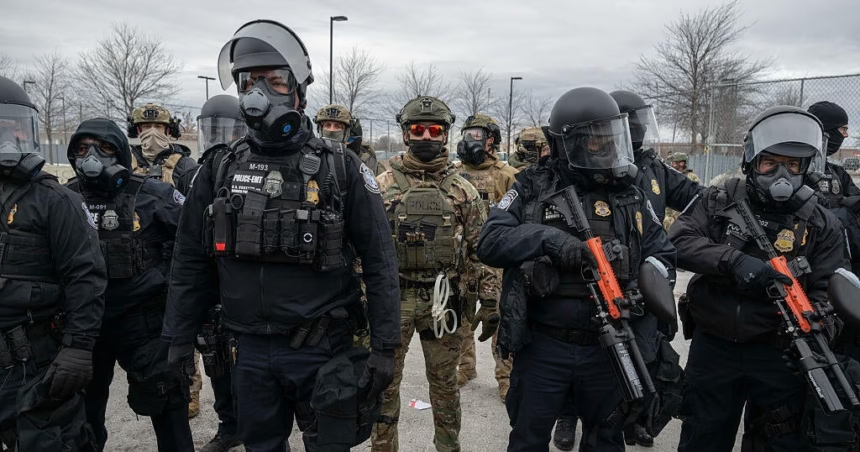
Mr. Trump’s threat comes amid protests over the deadly shooting of Renee Good by an Immigration and Customs Enforcement officer and increased tensions over immigration operations in the Twin Cities. The administration has sent thousands of federal law enforcement agents to the state in recent weeks to investigate fraud and implement the latest phase of its immigration crackdown.
The invocation of the Insurrection Act could clear the way for the Trump administration to deploy troops to the state over the objections of Democratic Gov. Tim Walz and local officials. Here’s what to know about the law:
What is the Insurrection Act?
The Insurrection Act has its roots in the 1790s and evolved over the decades, with the last substantive amendment coming in 1874. The law as written gives the president broad authority to deploy troops and enlist state militias to address unrest on U.S. soil, largely at his own discretion.
The statute has three main sections:
- The first says the president can deploy troops or militias if requested by a state to suppress an insurrection.
- The second authorizes the president to send in forces unilaterally whenever he determines that “unlawful obstructions, combinations, or assemblages, or rebellion against the authority of the United States, make it impracticable to enforce the laws of the United States.” He can deploy the troops “as he considers necessary to enforce those laws or to suppress the rebellion.”
- The third section says the president can use the military to stop an insurrection or conspiracy that obstructs federal law or violates constitutional rights when states fail to protect them.
“The basic idea, which emerged early on in the United States, is that there might be circumstances when state and local law enforcement resources and state and local militia, now the National Guard, would not be able to adequately contain protests or disturbances on the ground in their communities,” said William Banks, a professor emeritus at Syracuse University and expert on the domestic role of the military. “So the Insurrection Act allows the president to call forth the regular military or other federal forces to come into state or local communities and engage in law enforcement in an emergency circumstance.”
When can the Insurrection Act be used?
The law leaves it up to the president to determine when it should be invoked.
Joseph Nunn, a counsel at the Brennan Center for Justice who has studied the statute extensively, said the act has historically been a “tool for emergency situations when civilian authorities are overwhelmed by some sudden crisis — an insurrection, mass civil unrest.”
The law gives the president wide latitude to determine when an insurrection exists and how long troops can be used to address it. But “broad discretion is not the same thing as infinite discretion, and broad discretion can be abused,” Nunn said.
“The Insurrection Act was written to apply when all hell breaks loose. And when all hell breaks loose, of course, is in the eye of the beholder,” Banks said. He noted that the basis for triggering the act “is incredibly open-ended” and the statute “basically says the president can do this whenever he determines that it’s impractical to enforce the laws.”
“There are no procedural requirements, like a consultation with state and local officials, reports to Congress, sunsets — you know, do it for 30 days or 60 days, but then you’ve got to get out unless Congress renews it by statute, something like that,” Banks said. “It’s just open-ended. The president does it. He does it on his own say so, and he doesn’t have any particular criteria to follow.”
An 1878 law known as the Posse Comitatus Act generally forbids the use of the military for law enforcement purposes. But the Insurrection Act is the law’s “most important exception,” said Nunn, and its invocation means the Posse Comitatus Act does not apply.
When has the Insurrection Act been invoked?
The Insurrection Act and its predecessor have been used to address 30 crises over the years, according to a tally by the Brennan Center. It was invoked most recently in 1992, when President George H.W. Bush ordered troops deployed to California to suppress the L.A. riots at the request of the state’s governor.
The law has typically been invoked when states request assistance from the federal government. Presidents have invoked the act unilaterally only five times in the past 130 years, all during the Civil Rights Era, according to Nunn.
In 1957, President Dwight D. Eisenhower federalized the Arkansas National Guard and sent in the 101st Airborne Division to Little Rock to enforce desegregation. Kennedy invoked the Insurrection Act three times over the objections of state officials, once in Mississippi and twice in Alabama. Johnson also used the law unilaterally in Alabama in 1965.
“The idea is that it should rarely, if ever, be invoked, and indeed, in our history, it hasn’t been utilized very often,” Banks said.
Has Trump used the Insurrection Act before?
No, but he has threatened to.
In 2020, Mr. Trump entertained the possibility of invoking the Insurrection Act to deploy troops to cities across the U.S. in response to widespread racial unrest following the killing of George Floyd.
“If a city or a state refuses to take the actions that are necessary to defend the life and property of their residents, then I will deploy the United States military and quickly solve the problem for them,” he said in a speech at the White House in June 2020. He ultimately decided against doing so, with reports at the time indicating that administration officials were split over deploying troops.
Mr. Trump has also floated the use of the act since returning to the White House last year. In October, he told reporters that “if I want to enact a certain act, I’m allowed to do it routinely,” an apparent reference to the law.
“And I’d be allowed to do whatever I want,” Mr. Trump added. “But we haven’t chosen to do that because … we’re doing very well without it. But I’d be allowed to do that, you understand that, and the courts wouldn’t get involved, nobody would get involved, and I could send the Army, Navy, Air Force, Marines, I can send anybody I wanted. But I haven’t done that because we’re doing so well without it.”
Hasn’t Trump sent troops into other cities?
Yes, but he hasn’t used the Insurrection Act to do so, and a recent Supreme Court decision limited his ability to send in troops under a separate authority.
Last year, Mr. Trump ordered the deployment of National Guard troops to cities in California, Illinois, Tennessee and Oregon, as well as Washington, D.C., under an authority known as Title 10, the portion of the federal code that deals with the armed forces. The administration argued the troops were needed to support immigration agents and protect federal property.
Several cities and states where officials objected to the troops being deployed filed lawsuits seeking to block them. In one case, the state of Illinois and the city of Chicago sought an order barring the government from mobilizing and sending troops to the Chicago area, arguing Mr. Trump’s federalization and deployment of the Illinois National Guard was illegal. A district judge agreed and blocked the administration’s plans.
The dispute made its way to the Supreme Court. In December, the justices declined to freeze the lower court order in a narrow, preliminary 6-3 decision. A week later, Mr. Trump said the National Guard was leaving Chicago, Los Angeles and Portland.
“I think the Supreme Court ruling certainly makes it more likely that they will try to use the Insurrection Act,” Nunn said, while noting that the justices did not decide the case on the merits.
Why is Trump threatening to invoke the Insurrection Act in Minnesota?
The president said in his Truth Social post that he might invoke the law to protect the 3,000 ICE agents and other federal officers who have been sent to Minnesota in recent weeks as part of the administration’s immigration crackdown and fraud investigations.
The administration has targeted Minnesota on a number of fronts in recent weeks amid renewed scrutiny over massive fraud schemes that have been uncovered in the state over the past several years. The president and other administration officials have pinned the blame for the scandal on Walz, the governor and Democratic nominee for vice president in 2024. The increased immigration operations in Minnesota are taking place alongside a surge in federal resources aimed at investigating fraud.
Local officials have said the federal agents are responsible for inflaming tensions on the ground, pointing to the heavy-handed tactics of ICE agents and the deadly shooting of Good last week. Administration officials have said the agent was acting in self-defense and that protesters and activists are obstructing federal law enforcement.
Invoking the Insurrection Act would let the president deploy National Guard or active-duty troops to Minnesota to protect immigration agents and federal buildings. Using the act would, in theory, place the deployments on firmer legal ground than previous deployments.
But Nunn, the Brennan Center scholar, said the events in Minnesota do not warrant invoking the act.
“Basically, it exists for a kind of narrow set of crisis situations, and none of the criteria that would justify an invocation of the Insurrection Act are present in Minnesota,” Nunn said. “What exactly is the insurrection? There is no insurrection. Are the insurrectionists the people of Minneapolis? Who exactly is being protected?”
Nunn said that it’s “hard to say how much unrest there actually is.”
“But to the extent that there is any, it’s largely being fomented by the lawlessness and violence of ICE and [Customs and Border Protection]. And to the extent that there is violence, it is primarily being perpetrated by ICE and CBP,” he said. “And the government can’t go to an American city and foment unrest through lawless, violent conduct and then turn around and invoke the Insurrection Act, claiming that they need to do this to suppress that unrest.”
Could a court block Trump’s invocation of the Insurrection Act?
Yes, but a legal fight would take place in largely uncharted territory, according to Nunn. A president’s invocation of the Insurrection Act has never been blocked by a court.
“There’s very little case law on this subject,” Nunn said. “One, the Insurrection Act simply isn’t invoked very often. It’s a tool that’s used very rarely. Two, it has never been flagrantly abused in this way. There have been invocations of the Insurrection Act that I would say weren’t perfectly justified, weren’t obviously necessary, but it has never been outright abused.”
Nunn said that “no state has ever challenged an invocation of the Insurrection Act and there’s only ever been one case where anyone” has, a Supreme Court case known as Martin v. Mott in 1827. That decision found that the president has broad emergency powers, but Nunn said the particulars of the case mean it might not “reflect a general rule.”
“The available judicial precedent, which is very limited, suggests that there’s a fairly narrow set of circumstances where using the Insurrection Act is appropriate,” Nunn said. “Your argument would almost certainly be that the president has exceeded the scope of his discretion with the statute, that he’s using it for a situation that Congress did not intend to authorize.”
If a legal challenge made its way to the Supreme Court, Nunn said the justices’ Title 10 ruling might give a hint of how they would decide.
“One of the messages that should be taken from the Supreme Court’s ruling in December is that at least six justices are uncomfortable with the way that the Trump administration has been using the military domestically, and were uncomfortable with those deployments, which makes sense, because the Trump administration has been seeking to insert the military into civilian law enforcement on a scale that has no precedent in modern American history, and that runs afoul of the law in a variety of ways,” he said. “So it makes sense that the justices, the Supreme Court, would be uncomfortable.”