When Dr. Su Wang was in medical school, she donated blood. That’s when she learned she was infected with hepatitis B, a virus that attacks the liver and can lead to cancer and death decades later.
“I was 18, healthy, in college,” she said. “And suddenly I had a chronic illness I didn’t even know about.”
Born in Florida in 1975, Wang grew up before the hepatitis B vaccine was routinely given to newborns. For years, she assumed she had been infected by her mother, only to discover later that both her parents were negative. “It turns out my grandparents, who cared for me after birth, probably passed it to me,” she said. “That’s how easy this virus spreads — not from some exotic risk factor, just family.”
Today, Wang is the medical director for viral hepatitis programs at RWJBarnabas Health in New Jersey. Her story now sits at the center of a historic turning point in public health.
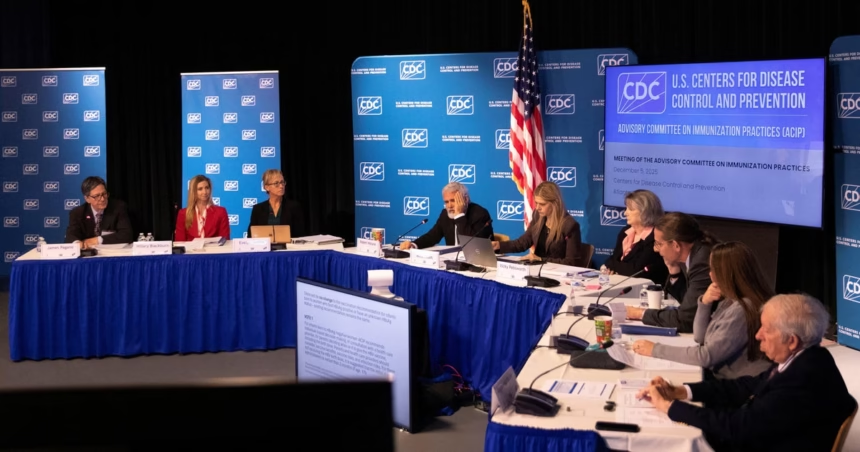
On Dec. 5, the Centers for Disease Control and Prevention’s Advisory Committee on Immunization Practices voted to end the universal U.S. recommendation for the newborn dose of the hepatitis B vaccine, instead adopting a policy urging individual-based decision-making.
Under the new approach, only infants born to mothers who test positive for hepatitis B will automatically receive a dose of the vaccine and hepatitis B antibodies shortly after birth. For everyone else, if the parents choose to vaccinate, the birth dose can be delayed until 2 months of age.
All the committee members were appointed by Health and Human Services Secretary Robert F. Kennedy Jr., a longtime anti-vaccine activist. In an 8-to-3 vote, the panel decided that since most pregnant women now receive hepatitis B testing, administering the vaccine at birth should be reserved for infants whose mothers test positive. They framed the shift as a way to reduce interventions deemed unnecessary, align vaccination with test results, and give parents more control over timing. Supporters of the decision described it as a move toward parental choice rather than a reflection of changing epidemiology.
But to many clinicians and epidemiologists, the change represents a dangerous rollback that could reverse three decades of progress toward eliminating a disease that still infects as many as 2.4 million Americans and kills tens of thousands each year. They see echoes of the 1980s, when risk-based vaccination left entire generations unprotected, and worry the country is about to repeat that mistake.
Moreover, the panel’s move on hepatitis B — in the face of overwhelming data that shows the birth dose is effective and safe — portends further upheaval for the nation’s childhood vaccine schedule, a cornerstone of public health.
“They’re not just trying to change one vaccine,” said Angela Rasmussen, a virologist and an editor of the scientific journal Vaccine. “They’re trying to dismantle how vaccine policy is made.”
Department of Health and Human Services spokesperson Emily Hilliard responded: “ACIP reviews all evidence presented and issues recommendations based on evidence and sound judgment to best protect America’s children.”
The authors of a new independent review by the Vaccine Integrity Project, which evaluated more than 400 studies and reports, warned in a public comment that delaying the birth dose “would reduce protection for infants and increase the risk of avoidable HBV infections, undermining decades of progress” toward eliminating the hepatitis B virus. The review was led by researchers at the University of Minnesota’s Center for Infectious Disease Research and Policy, which created the Vaccine Integrity Project in response to what it regards as Trump administration actions that “put the federal vaccine landscape at risk,” and it was vetted by outside experts.
“We fought hard for that universal birth dose because targeted approaches missed too many babies,” Wang said. “We know what happens when you wait.”
What’s unfolding now is not just a technical policy update but a fundamental test of the systems meant to protect the most vulnerable. The debate turns on a few critical questions — whether testing is reliable enough to replace universal safeguards, how infectious hepatitis B truly is, why past strategies failed, and what the CDC’s internal shake-ups mean for vaccine policy writ large.
The limits of testing
Hepatitis B testing sits at the center of the new ACIP recommendation, but even the CDC acknowledges that testing alone can’t guarantee protection. Pregnant women may test negative if the virus was acquired late in pregnancy or during the “window period,” before hepatitis B surface antigens become detectable. False negatives happen. No testing system, no matter how well designed, can catch every infection. That’s why universal vaccination was created in the first place.
If a mother’s status is unknown at delivery, hospitals are supposed to give the newborn a hepatitis B vaccine within 12 hours, adding hepatitis B antibodies for premature infants or if the mother later tests positive. But in real clinical settings, these safeguards routinely break down. Results take time. Nurses miss or misread labs. Pharmacies delay deliveries. Documentation gets lost.
“Every step you add increases the chance that something falls through the cracks,” Wang said. “Delaying the vaccine just adds another.”
ACIP’s vote shows how that logic is being challenged.
Some committee members suggested dropping the third hepatitis B shot if antibody levels look high after the second.
But Dr. Brian McMahon, a liver disease specialist who has spent decades treating hepatitis B, told the panelists that the data doesn’t support that idea. “Only maybe 20% to 30%” of infants have an adequate antibody level after the first dose, he said.
“You need two doses to really reach a high level of protection,” he said, with the third shot giving a stronger, longer-lasting response.
He said the overall message coming from the committee seemed designed to “discourage the birth dose.”
“They’re making it more and more difficult,” McMahon said.
In a second vote, ACIP also encouraged parents and clinicians to order post-vaccine serology tests — blood tests that measure protective antibody levels — after the second or third dose. The tests, ACIP said, should be covered by insurance.
More infectious than HIV or hepatitis C
Hepatitis B can survive on toothbrushes, razors, and household surfaces for a week. It spreads not just from mother to child but also through ordinary family contact: shared items, open sores, small blood exposures. In the 1980s, researchers found that about half of infections in American children came not from mothers but from other household members.
That’s why state health departments continue to insist that every newborn be vaccinated within 24 hours of delivery, regardless of maternal status. “Delaying vaccination misses a crucial period of potential exposure,” a New York advisory warned this year. The vaccine, it noted, is 80% to 100% effective when given on time.
The Vaccine Integrity Project report underscores the stakes. Since the universal birth dose was introduced in 1991, pediatric hepatitis B infections in the U.S. have dropped by more than 99%. A 2024 CDC analysis estimated that the current schedule has prevented more than 6 million hepatitis B infections and nearly 1 million hospitalizations.
The benefits are lifelong. Infants vaccinated at birth are shielded not just from hepatitis B but also from the liver failure and cancer it can cause decades later. Yet because the disease unfolds slowly, the consequences of policy shifts may not surface for 20 or 30 years.
Dr. Trieu Pham, a California physician, doesn’t need to imagine those consequences. Born in Vietnam in 1976, he probably contracted the virus at birth. “If the vaccine had existed then, I wouldn’t have gone through what I did,” he said. Diagnosed in his 20s, he developed cirrhosis by 40. At 47, he was coughing blood from ruptured esophageal veins. Eventually, he required a liver transplant to survive.
“You live with this constant fatigue and fear,” he said. “And the saddest part is it was preventable.”
His three children, all vaccinated within hours of birth, are free of hepatitis B. “That’s the difference a day can make,” Pham said.
A lesson already learned
In 1982, ACIP recommended the new hepatitis B vaccine only for adults at high risk: health care workers, injection drug users, and men who have sex with men. But by the late 1980s, it was clear that risk-based vaccination couldn’t contain transmission. Many newly infected adults didn’t fit any defined risk group. Identifying high-risk people proved imperfect, stigmatizing, and ultimately ineffective.
Meanwhile, infants infected during or shortly after birth had a 90% chance of developing chronic infection, compared with less than 5% in adults. Yet public health officials repeated the same targeted strategy, this time with newborns. In 1988, the CDC recommended universal prenatal screening and linked an infant’s vaccination to the mother’s test result, again basing protection on a risk marker instead of vaccinating all infants.
As before, it failed. Many infected mothers weren’t correctly identified. Some were never tested, some were tested too early, and others had results that were misread or never communicated. Too many infants slipped through the cracks, proof that another targeted approach couldn’t reliably protect them.
In 1991, the CDC issued its landmark guidance recommending that all infants, regardless of their mother’s infection status, receive a hepatitis B vaccine at birth, followed by two additional doses in infancy. By 2005, the policy was fully embedded in the routine immunization schedule, then reaffirmed in 2018. This evolution was based on data showing that a universal strategy, rather than a targeted one, was the most effective in preventing infections.
A matter of trust
The CDC’s new hepatitis B policy rests on the premise that moving the decision to parents will strengthen trust in the vaccine system. Supporters frame it as an empowerment shift — a way to give families more control.
In 1999, when it was last recommended to postpone the first dose of hepatitis B vaccine for infants born to uninfected mothers, vaccination rates also dropped among infants born to those who were infected.
“Opt-in policies sound patient-centered,” Wang said, “but in practice they’re inequitable. They leave behind the very families who need protection most” — the ones most likely to miss prenatal care and testing, have infections that go undetected or arise after testing, or slip through gaps in hospital care, as well as infants who can be exposed and infected by other caregivers and household members.
Those are often immigrant families, including from Asian and Pacific Islander communities in which hepatitis B remains endemic. “We already underdiagnose and undertreat these populations,” Wang said. “This change would deepen that gap.”
The United States is now the only country to abandon a universal hepatitis B birth dose recommendation. Though it will take decades to gather outcomes data, some researchers predict that delaying the first dose of hepatitis B vaccine to 2 months of age could result in over 1,400 preventable infections and about 300 cases of liver cancer per year.
“We don’t get to choose what we inherit,” Wang said. “But we do get to choose what we pass on.”
KFF Health News is a national newsroom that produces in-depth journalism about health issues and is one of the core operating programs at KFF — the independent source for health policy research, polling, and journalism.