ISLAMABAD:
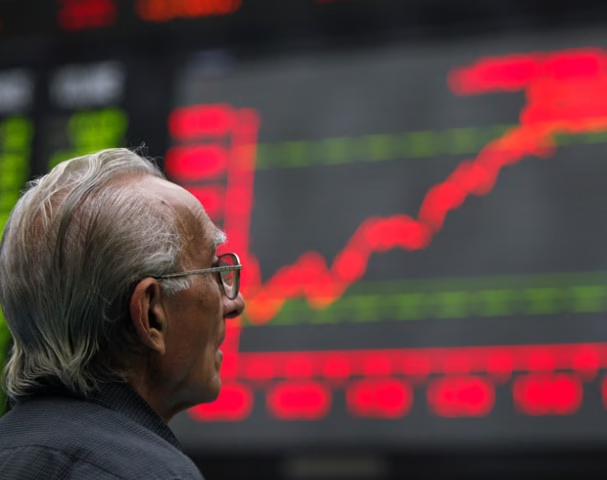
Stand on II Chundrigar Road in Karachi, the financial heart of Pakistan, in December 2025, and the mood is almost jubilant. The Pakistan Stock Exchange (PSX) has had a banner year, with the benchmark KSE-100 index surging nearly 40%, outperforming most regional markets.
Yet, travel a few hundred kilometers north to the industrial hubs of Faisalabad or Gujranwala, and the silence is deafening. It is the silence of idle looms, shuttered factory gates, and industrial estates operating at ghosts of their former capacity.
In late 2025, Pakistan presents a stark, almost schizophrenic economic reality. It is a tale of two economies operating in parallel universes. On one side is the “macro-stabilisation” narrative championed by Islamabad and applauded by international lenders – a narrative defined by fiscal surpluses, stabilised currency, and booming asset prices. On the other side is the “real” economy of production, exports, and employment, which is currently facing an existential crisis, being systematically asphyxiated by untenable energy costs and aggressive taxation.
This glaring disconnect raises an uncomfortable, defining question: If the stock market is hitting record highs while the factories that build the nation are hitting rock bottom, who is Pakistan’s economic recovery actually for?
To understand the current dichotomy, one must acknowledge the precipice from which Pakistan pulled back. In 2023 and early 2024, the country narrowly escaped sovereign default in the face. The subsequent turnaround, engineered through a punishing sequence of IMF programmes – culminating in the $7 billion Extended Fund Facility secured earlier this year – is remarkable, at least on paper.
The government’s adherence to fiscal discipline has been rigid. The State Bank of Pakistan, now operating with significant autonomy, crushed demand to tame inflation, bringing it down from dizzying double digits to below 5%. The critical lifeline of IMF tranches restored a semblance of confidence in foreign exchange markets, stabilising the rupee.
Investors, starved of yield and sensing that the immediate threat of total collapse had passed, flooded the equity market. The PSX boom is largely a liquidity-led rally, fueled by local investors pivoting away from a stagnant real estate sector and lower bank deposit rates. For the financial elite, the asset-holding class, and bond traders, 2025 has been a very good year. The narrative from the finance ministry is one of “mission accomplished” on the stabilisation front, arguing that the painful medicine has worked and the patient is out of the ICU.
However, the view from the factory floor suggests the patient has merely been stabilised by cutting off blood flow to the limbs. The real economy, particularly the export-oriented large-scale manufacturing sector, is bleeding out. The bellwether textile industry, responsible for over half of Pakistan’s exports and enormous reserves of employment, is in meltdown mode. By November 2025, industry associations reported the closure of over 100 major textile mills and nearly 400 cotton ginning factories across the country.
The primary assassin of the industry is no secret: the cost of energy. Pakistan’s power sector remains a black hole of mismanagement, theft, and disastrous contractual obligations. The infamous “circular debt” – the cascading chain of unpaid bills in the energy sector – has ballooned past Rs2.4 trillion. To plug this gaping hole, the government, bound by IMF conditionalities to stop subsidising power, has pushed tariffs to punitive levels.
In late 2025, industrial power tariffs in Pakistan are hovering between 12 and 14 cents per kilowatt-hour (kWh). In regional competitor nations like Bangladesh, Vietnam, and India, similar industries pay between 6 and 9 cents. In low-margin, high-volume businesses, like textiles, this differential is not a competitive disadvantage; it is a death sentence.
The pain is not limited to textile barons. The small and medium enterprise (SME) sector, the true backbone of the economy, is facing a similar squeeze. A small engineering workshop in Sialkot or a plastic vendor in Karachi faces the same electricity bills, compounded by an aggressive Federal Board of Revenue (FBR) desperate to meet revenue targets.
Lacking the financial cushion of large conglomerates, SMEs are folding quietly. Their closures don’t make headlines, but they represent a massive erosion of the country’s entrepreneurial base. The current tax regime, which often relies on regressive indirect taxes and high corporate tax rates, is incentivising the informal sector while punishing those in the tax net.
The human cost of this industrial hollowing-out is evident in the departure lounges of international airports. Pakistan is experiencing a historical rate of brain drain. In 2024, over 720,000 workers left the country for overseas employment. Data from the Bureau of Emigration suggests 2025 has seen a similar trend, with nearly 700,000 more departing by November.
While the government celebrates the resulting uptick in remittances – which are crucial for the current account balance – this exodus represents a catastrophic loss of human capital. It is not just labourers leaving for the Gulf; it is engineers, doctors, accountants, and IT professionals fleeing a shrinking job market. An economy that cannot employ its brightest minds is mortgaging its future for short-term foreign exchange inflows.
The paradox of 2025 lies in the fact that the mechanisms used to save the financial system are the very ones destroying the productive system. To satisfy creditors and build reserves, the government had to eliminate fiscal deficits. Unable or unwilling to tax retailers, real estate moguls, or the agricultural elite effectively, the state relied on its traditional cash cows: taxing salaried individuals, taxing existing industry, and raising utility prices.
As 2025 draws to a close, Pakistan stands at a precarious crossroads. The celebrations on the stock market are not entirely without merit; financial stability is a prerequisite for growth. But it is not growth itself.
A recovery that enriches asset holders while shuttering factories is unsustainable. An economic model that relies on remitted dollars from exported labour, rather than exported goods, is fragile.
If the current trend continues, Pakistan risks becoming a de-industrialised nation with pristine macroeconomic books but no productive engine. The KSE-100 may continue its upward march, but unless the government pivots rapidly to address the energy crisis and incentivise industrial production, the financial boom will remain a cruel mirage for the millions of Pakistanis waiting for the real recovery to begin.
The question remains: will the government prioritise the metrics that please international lenders, or the messy, difficult reforms required to restart the nation’s economic heart? An immediate choice is imperative before it is too late.
The writer is an international economist