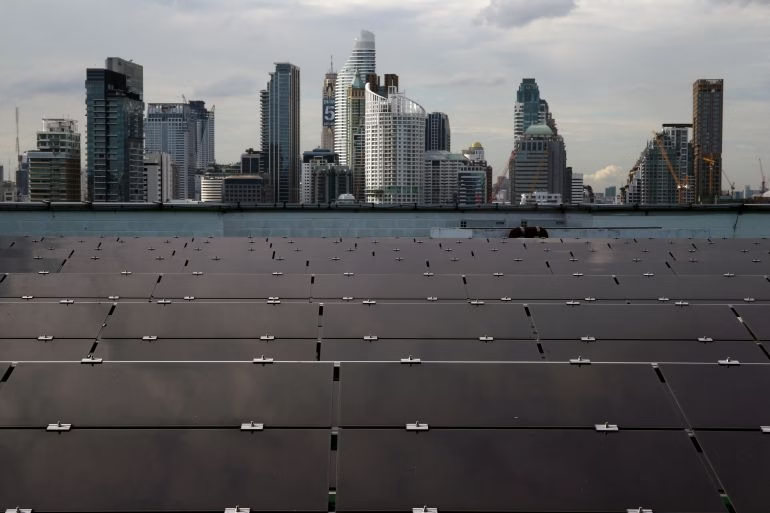
Bangkok, Thailand – A brief text message informed Chonlada Siangkong that she had lost her job at a solar cell factory in Rayong, eastern Thailand.
The factory operated by Standard Energy Co, a subsidiary of Singaporean solar cell giant GSTAR, shut its doors last month in anticipation of United States President Donald Trump’s tariffs on solar panel exports from Southeast Asia.
From Monday, US Customs and Border Protection will begin imposing tariffs ranging from 375 percent to more than 3,500 percent on imports from Thailand, Cambodia, Vietnam and Malaysia.
The punishing duties, introduced in response to alleged unfair trade practices by Chinese-owned factories in the region, have raised questions about the continuing viability of Southeast Asia’s solar export trade, the source of about 80 percent of solar products sold in the US.
Like thousands of other workers in Thailand and across the region, Chonlada, a 33-year-old mother of one, is suddenly facing a more precarious future amid the trade crackdown.
“We were all shocked. The next day, they told us not to come to work and would not pay for compensation,” Chonlada told Al Jazeera.
US officials say Chinese producers have used Southeast Asian countries to skirt tariffs on China and “dump” cheap solar panels in the US market, harming their businesses.
US trade officials have named Jinko Solar, Trina Solar, Taihua New Energy Hounen, Sunshine Electrical Energy, Runergy and Boviet – all of which have major operations in Thailand, Malaysia, Cambodia or Vietnam – as the worst offenders.

Thai solar exports to the US were worth more than $3.7bn in 2023, just behind Vietnam at $3.9bn, according to the latest US trade data.
Standard Energy Co’s $300m facility in Rayong had been in operation for less than a year, producing its first solar cell to great fanfare in August.
“I’m baffled by what’s just happened,” Kanyawee, a production line manager at Standard Energy who asked to be referred to by his first name only, told Al Jazeera.
“New machines have just landed and we barely used them, they’re very costly too – a few million baht for each machine. They’ve also ordered tonnes of raw materials waiting to be produced.”
Ben McCarron, managing director of the risk consultancy Asia Research & Engagement, said Southeast Asian manufacturers are facing a serious hit from the US turn towards protectionism.
“There are suggestions that manufacturing might exit Southeast Asia entirely if tariffs are introduced either in a blanket way, or that specifically address Chinese-owned manufacturing capacity in the region,” McCarron told Al Jazeera.
“The implications are significant for these countries; Thailand, Vietnam, Cambodia, and Malaysia accounted for about 80 percent of the US’s solar imports in 2024,” McCarron said, adding that “some manufacturers have already begun shutting down and moving out of the region”.
Unfair advantage
US officials and businesses have accused China of giving its solar firms an unfair market advantage with subsidies.
China was the largest funder of clean energy in Southeast Asia between 2013 and 2023, pouring $2.7bn into projects in Indonesia, Malaysia, the Philippines, Thailand, and Vietnam, according to Zero Carbon Analytics.
The American Alliance for Solar Manufacturing Trade Committee, a coalition of seven industry players, was among the loudest voices to lobby for a sharp rise in levies on Chinese imports.
Without a reprieve from the notoriously unpredictable Trump, companies affected by the tariffs have little recourse apart from the ability to file an appeal once a year, or after five years, once a “sunset review” clause takes effect.
Some observers believe the sector may never recover.
“It’s not just the low-skilled labour that was affected by the trade war; many workers in the solar cell supply chain are technicians, skilled labourers,” Tara Buakamsri, an adviser to environmental organisation Greenpeace, told Al Jazeera.
“Even if you make a lot of savings, solar cell exporters would still need to cut down on these skilled workers.”
Others take a more bullish view, arguing that, once the dust has settled, Chinese solar firms will drive the supply of products needed to meet regional emissions targets.
While Thailand, Cambodia, Malaysia and Vietnam welcomed Chinese solar companies in part due to the large sums of up-front investment on offer, they are all also seeking to meet more of their energy needs with cleaner sources.
Before Trump entered office with his tariff agenda, Thailand had announced plans to become carbon neutral by 2050 and produce net-zero greenhouse gas emissions by 2065.

“A slowdown [or halt] in solar exports as a result of US tariffs may supercharge efforts in Southeast Asian markets by Chinese solar companies, which see the region as a critical and well-aligned destination for green technologies,” McCarron said.
“Leftover supply from slowing exports could be absorbed by domestic markets in Thailand, Malaysia, Cambodia, Vietnam, particularly if governments use the situation as a cost-effective opportunity to rapidly accelerate policy initiatives that stimulate domestic solar.”
For Southeast Asia’s solar companies, survival is also likely to depend on governments cutting red tape and loosening the control of oil and gas monopolies over the energy mix.
At the same time, the US’s exclusion of Southeast Asian solar imports could hamper the shift towards greener energy in the world’s top economy.
“Thailand’s solar cell production is heavily export-driven and the US has historically been a major export destination,” Pavida Pananond, a professor of international business at Thammasat Business School in Bangkok, told Al Jazeera.
But solar tariffs will “also hurt American consumers and the green transition in the US as prices become higher”.