It felt like those we lost this year were as numerous as raindrops. Luminaries like Robert Redford, who challenged Hollywood to do better, to think harder, to take risks.
He was of Hollywood, but he preferred to live away from it. His Sundance Film Institute and Festival gave independent filmmakers a bit of sun at Sundance, promoting what he told “Sunday Morning” in 2018 were “the smaller stories. The more offbeat stories. The more controversial.”
Redford lived long enough to see fellow Oscar-winner Gene Hackman pass away. Hackman shone just as brightly. He could be gentle, as in “Hoosiers,” and powerful, as in “The French Connection.”
The real-life heroes from the civil rights movement are sadly getting more scarce every day. Sam Moore‘s song “Soul Man” was meant to show pride and resilience.
And there was one person who lived those values for 111 years: Viola Fletcher, the oldest witness to the Tulsa Race Massacre. Then there was Charles Person, the youngest among the original famed “Freedom Riders” protest in 1961. Joseph McNeil took a stand … by sitting, at a Whites-only Woolworth’s lunch counter. Jo Ann Allen, one of the “Clinton 12,” was among the first to endure the desegregation of schools all across the South. Bobby Cain was, too. He became the first Black student to graduate under those conditions.
A decade later, courage like that inspired the likes of Jesse Colin Young and the Youngbloods to record a song with a message of belonging, “Get Together.”
“Come on people now,
Smile on your brother,
Everybody get together,
Try to love one another right now”
The song permeated the Summer of Love. The late Sly Stone, of Sly and the Family Stone, got on board the inclusion train, too, with his song “Everyday People.” He certainly had an ear for the times.
Dick Cheney, who had an ear for politics, started his career the same year that song came out. He went on to become the most influential Vice President in history, especially in the wake of the September 11, 2001 terror attacks.
Asked by “Sunday Morning” in 2015 if he was changed by the events of that day, Cheney replied, “Well, it’s been alleged by some of my friends that 9/11 did change Cheney, that when he was a Secretary of Defense in the first Bush administration, he was a warm, pleasant, lovable fellow, and he became more of a hard rock afterwards. And I think that’s probably true.”
He remained a staunch conservative – until, that is, 2024, when he voted for Democrat Kamala Harris.
That’s similar to Supreme Court Justice David Souter. Nominated by President George H.W. Bush, he leaned more to the left in his later years. He left us at 85.
Right in the middle was Senator Alan Simpson, who balanced his conservative views with more moderate stands — a plain-spoken cowboy from the plains of Wyoming who got his wings at 93.
Peter Yarrow, of Peter Paul and Mary, got his wings this year, too. The tenor who helped bridge the gap between folk and pop was 86.
Jimmy Cliff (“I Can See Clearly Now”) bridged another gap: helping make reggae mainstream. The former choir boy from Jamaica found some of his inspiration in the traditions of gospel music, such as “Many Rivers to Cross.”
Pope Francis crossed that final river this year – a day after he blessed the faithful in St. Peter’s Square on Easter Sunday.
Whether you believe in Heaven as a destination or not, there’s no doubt the heavens are unending. Astronaut James Lovell never landed on the moon, but saw it closer than most. He took to the skies for the last time at age 97.
Back on Earth, astrophysicist Fred Espenak was chasing our galaxy with a telescope. He witnessed the moon blot out the sun 52 times – a sci-fi experience in real life.
We lost others who imagined life beyond the stars – in movie posters. Drew Struzan was the artist behind the theater posters for the “Star Wars” films and the “Back to the Future” trilogy. Renato Casaro gave life to blockbusters like “Rambo” and “Terminator 2.”
And then there was Joe Caroff, the artist who created the James Bond logo.
We also lost some who appeared in those classic Bond films – tough guys like Bruce Glover, the assassin in “Diamonds Are Forever”; and Joe Don Baker, the arms dealer in “The Living Daylights.”
And so many, many more: Graham Greene (“Dances With Wolves”); Enzo Staiola (“Bicycle Thieves”); Pat Crowley (“Forever Female”); Patrick Adiarte (“The King and I”); Cary-Hiroyuki Tagawa (“Mortal Kombat”); Michael Madsen (“Reservoir Dogs”); and Sally Kirkland (“Anna”).
We lost Rebekah Del Rio, that unforgettable singer in “Mulholland Drive,” the same year that we lost director David Lynch who put her in that film.
In 2016 Lynch told “Sunday Morning” that people should not confuse the characters in his movies with his state of mind: “Stories are stories,” he said. “And like I say, the artist doesn’t have to suffer to show suffering.”
Oscar-nominee Diane Ladd offered plenty of suffering in Lynch’s “Wild at Heart.” Her daughter, Laura Dern, and the rest of her fans mourned her loss at 89.
Sharing a spot on the Hollywood Walk of Fame with Ladd, far from the beach, was the Beach Boys’ Brian Wilson. Wilson was called the poet laureate of surf culture.
But when it came to the poetry of baseball, there were few better than Bob Uecker. He was a ballplayer who became “Mr. Baseball,” a pioneer for his wit and self-deprecating humor. Asked by “Sunday Morning” in 2024 his favorite Bob Uecker line, he replied, “Just a bit outside. That’s where my wife put me a lot of times!”
Nina Kuscsik was left outside of the men in marathons – until, that is, she became the first woman to enter the New York City Marathon, and the first official female winner of the Boston Marathon.
In figure skating, Dick Button was the first to land a double axel, and the first American to bring home gold in Olympic figure skating – twice.
Button was elegant and fierce, much the way George Foreman was in the boxing ring. He got a heavyweight world title in his 20s – and then unbelievably again in his 40s. And even if you never saw him box, you probably saw him cook. He described his George Foreman Grill as a real “knockout.”
Another ringmaster – and master marketer – was Hulk Hogan, the face of professional wrestling for decades. He was the ultimate showman, who died of cardiac arrest at age 71.
There were, this year, so many unnatural deaths, especially, it seems, on college campuses, from Brown University just before Christmas, to Utah Valley University, where political activist Charlie Kirk was murdered. He was there organizing young voters around Christian conservative values. The students who saw what happened will never be the same.
Anne Marie Hochhalter survived the mass shooting at Columbine High School in 1999, but 26 years later it caught up with her. She died from injuries related to the shooting that left her paralyzed. She was only 43.
It’s hard to fathom just how much life does come after a tragedy. John Cleary was shot on the campus of Kent State University, a moment captured in a Life Magazine photo. But he ended up finishing his degree in architecture. He lived another 55 years.
We lost others in architecture, too. David Childs designed the Freedom Tower in the wake of 9/11.
We lost Frank Gehry, perhaps the most recognizable American architect since Frank Lloyd Wright.
And then there was Giorgio Armani, an architect of fashion, who turned red carpet events into press conference. Who was wearing him got a lot of coverage.
So many of those who asked the questions trying to get answers about all kinds of things left us this year, like our colleague Mark Knoller. With his booming voice, and a treasure trove of presidential trivia, he gave CBS’ White House coverage a real spark. Morris Banks, a cameraman who was equally intimidating in stature, travelled the world for CBS to brings us stories of people and events. The same was true of “Sunday Morning”‘s Jim McLaughlin.
And indeed, so many, many more: CBS cameraman Dave Dorsett; William Galbraith, chief editor, CBS News, Washington; CBS News producer, editor and writer Jerry Mazza; Chuck Milton, of CBS Sports; CBS News correspondent Ed Rabel; CBS News editor Seth Fox; Belva Davis, anchor, CBS News in San Francisco; Peter Arnett of CNN; and NPR’s Susan Stamberg. Asked by “Sunday Morning” in 2021 about the future of radio, Stamberg replied, “People will always listen and want to hear stories told by human voices.”
Human voices, sometimes shouting in the wilderness, can do remarkably good things, even if those voices are voicing pain. Virginia Giuffre was the first of Jeffrey Epstein’s victims to go public. Soon, other survivors joined her. They began speaking with one voice – shining lights in the dark. In 2020 she told “CBS This Morning,” “The buck stops when every single monster gets held accountable and our children are safe. And we need everyone’s help.”
Giuffre was just 41.
Conservationist Jane Goodall raised her voice from the jungles of East Africa, where her work with chimpanzees made us look at ourselves – and our relationship with the animal kingdom – in a different and special way. In 1990 she said, “We’re not quite as different from the rest of the animal kingdom as we used to think.”
In fact, animals can seem every bit as human as we are. June Lockhart played Lassie’s “mom,” among a lot of other roles. She was always just as intuitive as Lassie herself.
That Golden Era of TV started the career of Rob Reiner, too, and while he was a good actor, it was directing where he really made his mark. Name some of your favorite movies and chances are Reiner directed them. From comedy (“This Is Spinal Tap,” “When Harry Met Sally,” “The Princess Bride”), to drama (“Misery,” “A Few Good Men”), he had his finger on our pulse the way few people did.
Rob Reiner, and his wife Michele, left us far too soon.
Another familiar face was George Wendt. As Norm on “Cheers,” there’s no wonder everybody knew his name. Wendt was 76.
We also lost David Ketchum from “Get Smart”; and Malcolm Jamal Warner, from “The Cosby Show.” It’s hard to think of any of them getting any older. Take TV’s Dennis the Menace: Child actor Jay North couldn’t stay young forever. He was 73 when he died at his home in Florida.
And then there was actor Richard Chamberlain, who played the young intern Dr. Kildare. He went on to star in blockbuster TV miniseries like “Shogun” and “The Thorn Birds.”
Both those novels hit the bestseller list – and so did the “Confessions of a Shopaholic” series, authored by Madeleine Wickham, who wrote under the pen-name Sophie Kinsella.
In 2014 she told “CBS This Morning,” “You’re hoping that people will enjoy your book, but you don’t know, and off it goes. But then you meet somebody who says ‘Well you know what, I ,,read your book in the middle of the night while I was recovering from operation, and it got me through.’ I mean, how could you do anything better in life than that?”
The British author died of brain cancer at just 55.
Few British playwrights have been compared to Shakespeare, but Tom Stoppard was. In 1999 he told “Sunday Morning,” “It seemed to me that having a play on at the National Theatre, for example, was some kind of Everest which only a chosen few could ever even hope to aspire to. It turns out to be something that can happen to people like me.”
He was 88 when he slipped this mortal coil.
For all the creative writers and performers that we did lose this year, we were really struck by the sheer number of TV personalities who passed away: Polly Holliday (“Alice”); Loni Anderson (“WKRP in Cincinnati”); Lulu Roman (“Hee-Haw”); Ruth Buzzi (“Rowan & Martin’s Laugh-In”); Prunella Scales (“Fawlty Towers”); Danielle Spencer (“What’s Happening!!”); Lynne Marie Stewart ( “Pee-Wee’s Playhouse”); and Loretta Swit (“M*A*S*H”).
Portrayals of those in our nation’s uniform rarely get better than “M*A*S*H” or, later, “Top Gun.” Few could top Tom Cruise as a cocky Naval aviator, but Val Kilmer did. He played so many other roles, from Jim Morrison of The Doors, to Doc Holliday in “Tombstone.” “I like characters,” Kilmer told “Sunday Morning” in 2013. “I think that’s what people have enjoyed most in my acting.”
But it was “Iceman” that stuck with all of us right till the very end. Val Kilmer was 65.
Airmen who saw real combat in World War II are few and far between these days, like John “Lucky” Luckadoo. They called him that because he survived so much, and he continued to, making it to 103.
Joe Harris lived to 108 – one of the oldest WWII paratroopers.
George Hardy earned his wings at just 19, making him one of the youngest Tuskegee Airmen. Jessie Mahaffey survived the attack on Pearl Harbor – and the sinking of another ship just a year later. he was 102. Donald McPherson distinguished himself as an “ace” in the skies above Okinawa. Julia Parsons, one of the last Enigma code breakers, left us, too, this, year.
Sal Veder/AP 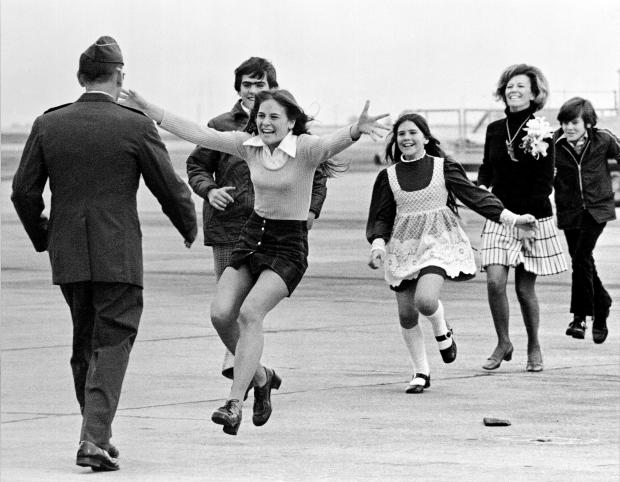
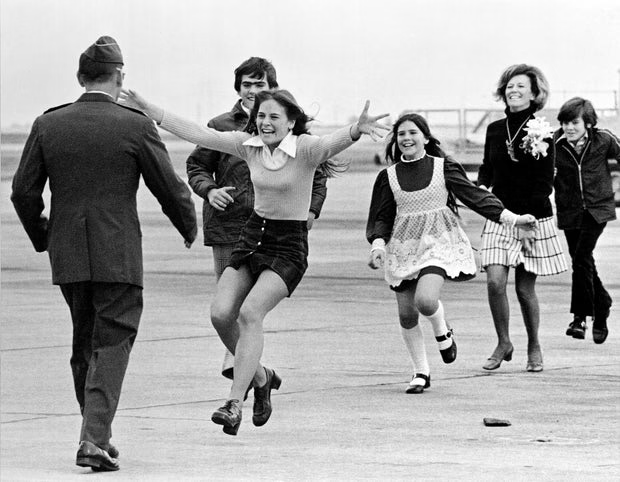
Some, however, never came home, but Vietnam POW Lt Col. Robert Stirm finally did. The Pulitzer Prize-winning picture said it all – his family seeing his face for the first time in almost six years.
Words never matched those feelings, but lyricist Alan Bergman‘s words got pretty close. He and his wife, co-writer Marilyn Bergman, are perhaps best known for the classic “The Way We Were.”
So many couples we remember the way they were, like Dorothy Vogel and her late husband Herb. On modest means, upstairs in their rent-controlled apartment, they amassed an art collection worth millions. True to their modesty, before their deaths, they gave most of it away.
What Rick Davies gave away was his artistry behind the Wurlitzer electric piano. It gave the supergroup Supertramp its signature chart-topping sound. He was 81.
We lost “Space Ace” – Ace Frehley – of the heavy metal group Kiss this year, too. He made fans believe his playing really did make his guitar smoke (and maybe it did!).
And then there was Ozzy Osbourne, the lead singer of Black Sabbath and self-described Prince of Darkness. His wife, Sharon Osbourne, stayed with him through thick and thin. Asked by “Sunday Morning” in 2012 what their secret was, Ozzy replied, “I don’t know. You know, I’m in the rock and roll. Because you rock and you roll. You know, you just get on with it.”
Those musicians who have just “gone with it,” like D’Angelo and Connie Francis, still left us their talents that make us, as trumpeter Chuck Mangione did, feel “so good” … like Bobby Sherman (“Julie, Do Ya Love Me”); John Lodge of The Moody Blues (“Nights in White Satin”); and Marianne Faithfull (“As Tears Go By”);
There was also singer and guitarist Wayne Osmond of The Osmonds (“Crazy Horses”), and Mark Volman of The Turtles (“Happy Together”).
“Happy together” just might describe what most people were feeling when they were in the company of the legendary Diane Keaton. Some called her quirky, even kooky. But everyone agreed she was talented beyond measure. She could do searing dramas and romantic comedies, always holding her own with the best of them. “I think that one of the reasons I’ve been able to be around for as long as I have, is because I have been in funny movies,” she told “Sunday Morning” in 2010.
She left her mark not only as an actor, but with her fashion sense, too.
Keaton was certainly unique, as most of those we remember are. There are far too many to name. But for their talents, their passions, their love and care and influence, we are forever grateful.
To all of them we bid a very fond “Hail, and Farewell.”
Story produced by Young Kim. Editor: Steve Tyler. Digital producer: David Morgan.
For images thanks to: