PUBLISHED
December 28, 2025
As the political air around India is thick with the threat of increased minority persecution at home and murmurs that Delhi is turning rogue abroad, an unexpected frontline of Hindutva is taking shape thousands of miles away: the Hindu American Foundation (HAF), a US-based organisation that has mastered the art of cloaking a majoritarian project in the language of American liberalism.
The HAF has emerged as one of Hindutva’s most diligent custodians on foreign soil, quietly and at times leaping at its critics’ throats to fortify its ideological frontiers and assert an Islamophobic narrative, often in alliance with the American far-right.
Its leadership and founding personnel trace roots to older Hindu-right organisations, some of which are linked to Rashtriya Swayamsevak Sangh (RSS), such as the Vedic Foundation (VF) and Hindu Education Foundation (HEF).
More recently, the organisation openly rebuked Western media outlets, including the New York Times, for “whitewashing” the Pahalgam attack in Indian-occupied Kashmir, calling them out for ignoring the “religious element” of the attack.
Suhag Shukla, executive director of the organisation, even suggested a better framing of the attack: “Hindus massacred in Kashmir by Islamists in a terror attack by Pakistan-backed group”.
A 68-page investigation produced by Rutgers Law School in New Jersey earlier this year offers a stark assessment of how the organisation does this.
The report, “Hindutva in America: A Threat to Equality and Religious Pluralism”, traces how these groups have strategically ridden the currents of post-9/11 Islamophobia, leveraging the political and cultural climate generated by the so-called “war on terror” to normalise and advance an ethnonationalist project within American public life.
“By couching their rhetoric within the mainstream narrative that Muslims worldwide are presumptively terrorists and violent, Hindutva organisations join the chorus of other anti-Muslim right-wing groups.”
The study further identifies two core objectives guiding Hindutva’s diaspora strategy in the US: the systematic construction of Muslims as perpetual outsiders and security threats, and a sustained effort to curtail academic freedom by intimidating scholars, policing curricula, and narrowing the space for critical inquiry.
On one side, HAF keeps a polished, liberal-friendly exterior, borrowing the vocabulary of pluralism and progressive inclusion while scrumptiously smuggling in Hindutva’s conceptual DNA. On the other hand, it lashes out at scholars, journalists and activists who try to expose the toxin hidden beneath its rhetoric.
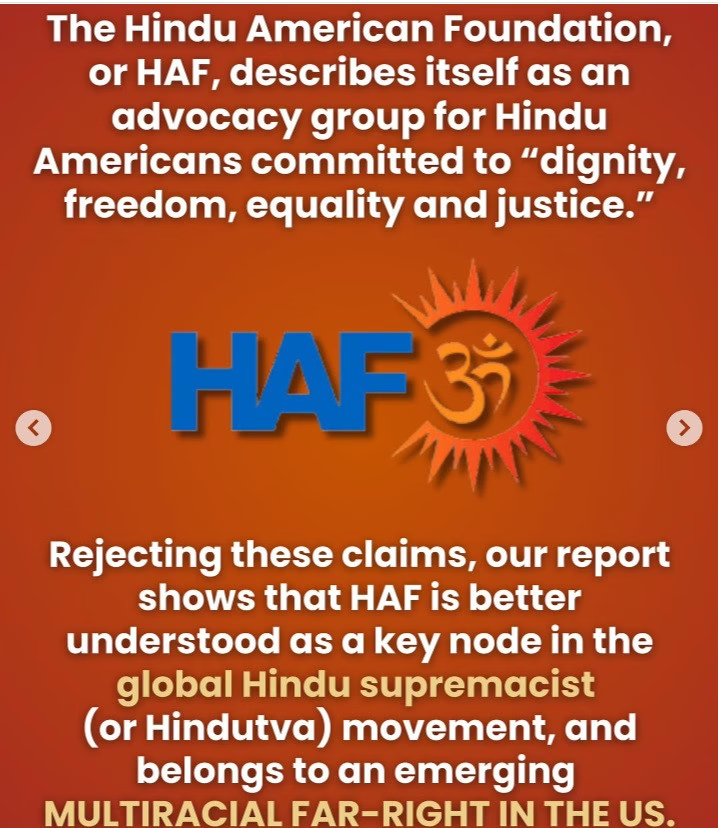
Multiracial far-right
A report released last year by Political Research Associates (PRA), together with the Savera: United Against Supremacy coalition, pressed this into view.
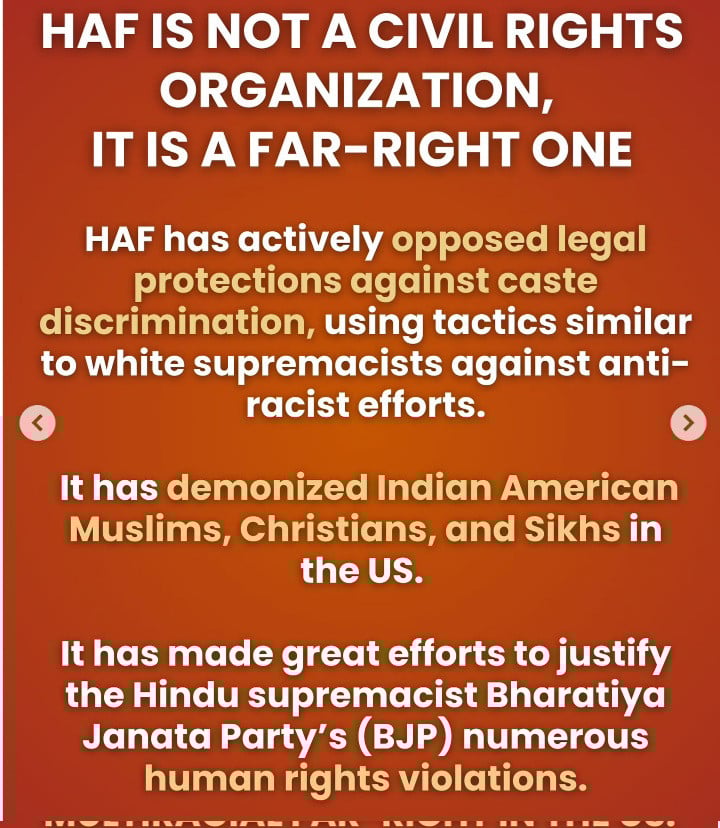
Titled “HAF Way to Supremacy: How the Hindu American Foundation Rebrands Bigotry as Minority Rights,” the study argues that HAF’s advocacy operates through a fundamentally antagonistic logic in which “the civil rights and religious freedoms of Hindus are framed in opposition to, and at the expense of, those of other communities”.
The report situates HAF’s role within a broader ideological assemblage of Hindu-right actors and supremacist currents in the US. Through this alignment, the organisation becomes a conduit for Islamophobia, casteism and other exclusionary narratives circulating within segments of the Indian American community.
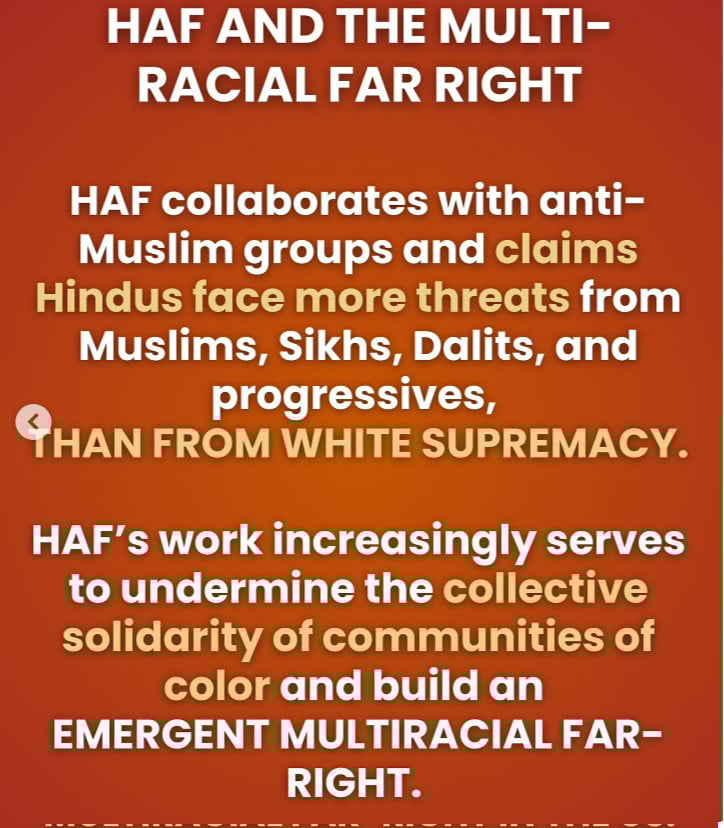
The political effect is twofold: the erosion of coalitions among communities of colour, and the quiet recruitment of Hindu Americans into what the report describes as an emergent “multiracial far-right”.
By resisting civil rights protections for caste-oppressed groups, amplifying dehumanising portrayals of Muslims and attempting to insulate the Modi government from criticism, HAF has, according to the study, entered into a shared ideological orbit with a range of far-right organisations.
The report shows that none of this is accidental or sudden. Rather, the organisation’s trajectory reflects its origins: a project incubated by second-generation Hindutva activists who had been shaped by older and more openly supremacist formations.
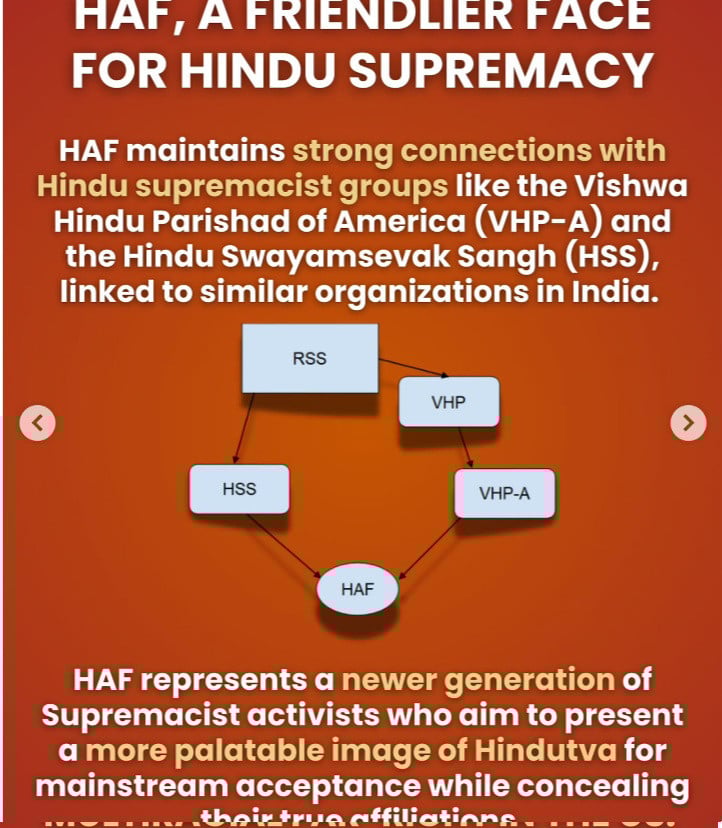
HAF’s public strategy, the report notes, was to offer a more polished, seemingly liberal-friendly face of Hindutva while continuing to maintain covert linkages with bodies such as the Hindu Swayamsevak Sangh (HSS) and the Vishwa Hindu Parishad of America (VHP-A).
The study concludes that the rise of a multiracial far right in the US makes it urgent for civil society to recognise the ideological threat posed by such groups, which undermine the possibilities of an authentically democratic multiracial political horizon.
“The Hindu supremacist movement is a dangerous and increasingly influential force within an emergent multiracial Far Right in the United States,” said Tarso Luís Ramos, Executive Director of Political Research Associates. “The Hindu American Foundation has cleverly exploited the general lack of awareness in this country about Hindu supremacism to present itself as a civil rights organisation. This report sets the record straight: HAF is a stalking horse for Hindutva and must be understood as an extension of the Indian Far Right.”
Lawsuits and academic pressure
When the soft rhetoric does not suffice, HAF does not hesitate to deploy harsh tactics like lawsuits, reputational pressure and public condemnations.
In May 2021, HAF filed a defamation and civil-conspiracy lawsuit against a group of activists and academics, including co-founders of Hindus for Human Rights (HfHR), a Christian-organisation representative and Rutgers University Professor Audrey Truschke.
The suit followed Al Jazeera articles and associated commentary that described HAF as having ties to Hindu supremacist and religious-majoritarian groups in India.
The legal campaign was explicit as it involved the portrayal of HAF as aligned with extremist ideology — or as acting as an agent of majoritarian power — and was characterised as defamation.
HAF accused the defendants of misrepresenting relief-fund usage (they had allegedly misused COVID-19 PPP funds) and of labelling HAF as having “parent organisations” connected to extremist groups.
In 2022, the court dismissed the case. The judge found that even if some statements were “verifiably false,” the suit failed on procedural grounds: lack of personal jurisdiction over the defendants, and failure to meet the high “actual malice” standard required when public-figure plaintiffs sue for defamation in the US.
Scholars and civil-rights advocates widely criticised HAF’s tactics as a strategic lawsuit against public participation (SLAPP), aimed at chilling dissent and academic critique. That lawsuit, even though unsuccessful, worked as a warning.
Hindutva memory politics
“Many Hindu Right groups operate abroad, including in the United States. Some are registered as foreign agents in America, such as the Overseas Friends of BJP, whereas others are registered non-profits, such as the HSS and VHPA,” says esteemed historian and Rutgers University Professor Audrey Truschke. Dr Truschke was also sued by the far-right organisation merely over Twitter posts in which she criticised HAF and Hindu nationalist ideology.
According to Dr Truschke, Hindu Right groups in the US share some similar activities with those in India, and some are distinct. For example, all these groups attempt to spread Hindutva propaganda about Indian history.
“The HSS, for instance, disseminates pamphlets that offer mythologies of Hindu glory days… Hindu Right groups in the United States often focus on childhood education, perhaps reflecting the anxiety—common to many immigrant communities—of losing one’s children to broader American cultural assimilation,” says Professor Truschke.
“The US-based Hindu Right also allies with other alt-right movements in the US context, including Islamophobic groups and, perhaps more surprisingly to some, white nationalists.”
One of the most consequential battlegrounds for diaspora Hindutva is the US classrooms. HAF, often in coordination with other Hindu-right-linked organisations, has repeatedly intervened in state-level textbook adoption processes, arguing for revisions to how Indian history, religion, and caste are presented.
As early as 2006, HAF (along with other Hindu organisations) challenged California’s decision to reject most proposed textbook edits intended to sanitise or reshape presentations of caste, ancient history (e.g., Indo-Aryan migrations, which is a favourite of Modi supporters back home), the status of women and other contested aspects of the Indian past.
The court ultimately ruled against HAF’s challenge, retaining the contested textbooks. It concluded that portrayals of Aryan migrations and the caste system did not violate legal standards of neutrality or fairness. The historical reality of caste and migration was deemed legitimate to teach.
Nevertheless, the process resulted in a settlement as the Board agreed to share some legal expenses and both sides claimed partial victory.
More recently, HAF again lobbied during the California textbook-adoption process, submitting letters, petitions, and commentary, aiming to influence how South-Asian histories, including Hinduism, caste and migration, are taught.
“Rewriting school textbooks to introduce alt-right propaganda is an activity we see pursued by Hindu Right groups in India and in the US,” Dr Truschke observes.
Caste politics
Similarly, the politics of caste has become a central fault line in HAF’s diaspora strategy. While caste remains a live, controversial issue in India and among South Asians abroad, HAF has consistently argued that caste-based protections (as civil-rights policy) are unnecessary, unfair, and discriminatory. This is a strategy that echoes caste-caste denialism and upper-caste defensiveness.
In 2023, the California state legislature debated Senate Bill 403 (SB-403), which would explicitly add “caste” as a protected category under civil rights law. HAF formally opposed the bill. In a public letter to state lawmakers, HAF argued that the bill’s “legislative intent and impact will result in an unconstitutional denial of equal protection and due process to South Asians …” and claimed it would amount to profiling based on national origin, ethnicity or ancestry.
HAF conceded that caste discrimination should be dealt with, but insisted that any incidents should be “investigated under existing law,” rejecting the need for a specific protected category. Ironically, Dalit rights groups, civil-rights activists and other Indian-American organisations saw this as yet another attempt to erase caste as a systemic reality and deny structural discrimination.
When SB-403 passed the state legislature, HAF intensified its lobbying, and eventually the bill was vetoed by Governor Gavin Newsom in late 2023. HAF celebrated the veto as a vindication of its position.
Funding
As a 501(c)(3) non-profit, HAF has established institutional legitimacy and financial structures that anchor it within both Indian-American and broader US civil society landscapes.
According to Professor Truschke, Hindu Right groups in the US also serve some specific functions, including attempting to influence politicians in the country and fundraising from a notably wealthy diaspora. Indian Americans are about twice as wealthy as the average American.
The institutional embedding allows HAF to operate in multiple arenas: policy-advocacy, curriculum influence, media narratives, legal pressure, and fundraising from wealthy Indian diaspora donors.
Moreover, this embedding gives HAF access to resources, influence and respectability in the form of tax-exempt status, non-profit legitimacy and the ability to frame itself as a civil-rights advocate rather than a political lobby.
“The US-based Hindu Right is Janus-faced when it comes to majoritarianism. They argue against this in the United States, invoking a language of minority rights and religious freedom, while advocating for Hindu supremacy in India,” Dr Truschke observes.
Moreover, the historian argues that the HAF uses its stance on the former to try to shield its odious politics on the latter from criticism. “Fewer people are buying into this bad-faith argument as India’s treatment of its religious minorities continues to degenerate, with an increasing number of people warning of India even being in danger of a genocide.”
Several scholars and journalists contacted for this article declined to speak on the record, even after the HAF’s defamation case was dismissed. Some cited direct legal exposure, others pointed more vaguely to professional risk and sustained harassment. The reluctance itself is instructive.