PUBLISHED
November 02, 2025
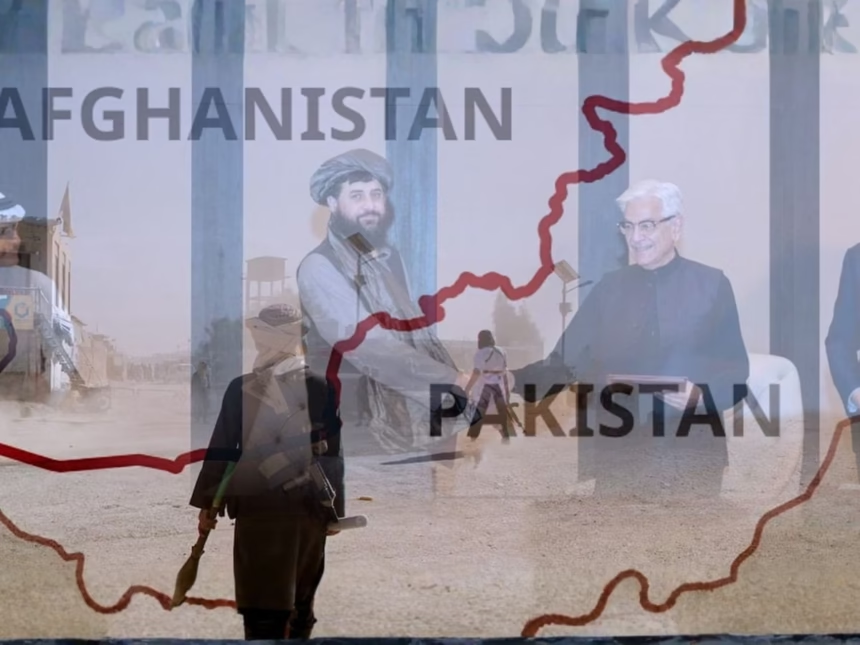
The latest negotiations round held in Istanbul, Türkiye, from October 25th to 30th, 2025, between the Afghan Taliban and Islamabad ended with an interim understanding to implement the ceasefire that was earlier agreed in Qatar. Further technicalities of the interim understanding will be discussed in the next round of talks that will start on November 6th, 2025. The international mediation and continued dialogue for the past several weeks is a good omen; however, the prospects for successful dialogue and conflict resolution between Islamabad and the Afghan Taliban remain slim and unpredictable.
It is primarily due to deteriorating bilateral ties between the two neighbors since August 2021. Before Türkiye and Qatar, China also made an effort to give peace a chance between the two neighbors in a series of trilateral talks, but to no vein. There are four principal factors that render the peace efforts between the two actors inherently fragile, thereby diminishing the likelihood of sustainable peace.
Firstly, Pakistan and the Afghan Taliban lack a shared understanding or unified stance on their principal point of contention – the issue of terrorism and the Taliban’s support for the Fitna al Khwarj (Tehrik-i-Taliban Pakistan (TTP) and Fitna al Hindustan (Balochistan Liberation Army (BLA).
Since 2021, Islamabad has kept on urging Kabul to take decisive actions against the TTP and BLA, citing the groups’ role in exacerbating Pakistan’s security challenges, especially in the tribal borderland regions and the Balochistan province. Conversely, the Afghan Taliban claim that they do not exercise any kind of control over either TTP or BLA.
Especially, they have a soft corner for TTP, given their shared religious ideology and decades-long historical experience as insurgent movements. For such groups, the use of force – including acts of violence and terrorism – is often perceived as a legitimate tool of asserting their authority on the targeted population. This fundamental divergence in perspectives over the central issue significantly undermines the prospects for any substantive and lasting conflict resolution between Kabul and Islamabad.
“The Afghan Taliban claim that they do not exercise any kind of control over either TTP or BLA. Especially, they have a soft corner for TTP, given their shared religious ideology and decades’ long historical experience as insurgent movements”.
Secondly, the dialogue that commenced in 2025 after a deadly conflict between the two countries should ideally have begun in 2021, when the Afghan Taliban assumed power and the TTP, emboldened by the Taliban resurgence in Afghanistan, reactivated its operations and intensified terrorist activities in Pakistan.
Most importantly, both the neighbors needed to engage each other at different levels and platforms to negotiate various issues of mutual concern, such as border security and management, repatriation of refugees, counterterrorism and TTP’s relocation from Afghanistan.
The prolonged delay and lack of will in such engagement between Kabul and Islamabad has further deepened the pre-existing trust deficit – a historical feature of Pakistan-Afghanistan relations largely rooted in the issue of Kabul’s irredentist claims about the Durand Line. Instead of addressing ground realities and sources of trust deficit, both sides resorted to mutual accusations and blame shifting.
Consequently, these belated diplomatic efforts, following years of mistrust, will require substantial time and commitment to rebuild confidence – particularly, at the grassroots level, where communities on both sides of the border express a genuine desire for conflict resolution and confidence-building measures.
A third significant factor shaping Pakistan-Afghanistan relations is the complex geopolitical environment, particularly India’s recent efforts to cultivate friendly ties with the Taliban regime in Kabul. The visit of Taliban’s Foreign Minister, Amir Muttaqi, to New Delhi in October 2025 has been viewed by many as an Indian effort to diplomatically isolate Pakistan and create a two-front challenge that could strain Islamabad’s strategic position and capabilities.
The broader South Asian region, and Afghanistan in particular, already face acute socio-economic hardships and political uncertainties and any such geopolitical maneuvering by India and Afghan Taliban can further destabilize the region, leading to severe development and human security repercussions.
It is imperative for India to recognize the fact that provoking the diplomatically and politically inexperienced Taliban will not confine the ensuing conflict and its repercussions to Afghanistan and Pakistan alone; rather, it will create long-term regional consequences that all states in South Asia will have to bear.
Lastly, peacebuilding, negotiation and conflict resolution require all parties to possess both the political will and diplomatic capacity to engage constructively. In the case of the Afghan Taliban, they appear to lack both. Their close association with TTP and other militant and insurgent groups undermines their willingness to confront and resolve the conflict with Pakistan, particularly given that the core of the dispute lies in the Islamic Emirate’s continued logistical and political support for the TTP and BLA.
In terms of capability, the Taliban leadership also suffers from limited diplomatic exposure and training. The Taliban’s political office in Qatar had previously demonstrated a degree of political maturity due to its sustained exposure and engagement with the international community that resulted in the 2020 peace deal between the US and the Taliban.
“Most importantly, both the neighbours needed to engage each other at different levels and platforms to negotiate various issues of mutual concern such as border security and management, repatriation of refugees, counterterrorism and TTP’s relocation from Afghanistan”.
However, once the Taliban rank and file returned to power, they sidelined the leadership from the Qatar office, hence leaving its members with little influence over the Taliban’s important decisions. The prominent role of Mullah Yaqoob – a former Taliban commander and current Defence Minister of the Taliban – in the first round of negotiations in Qatar indicated that the Taliban were approaching this issue from the position of power rather than with the element of diplomatic and political will and maturity – a factor that further diminishes the prospects for a negotiated settlement for Pakistan and Afghanistan.
It is imperative to consider these four critical factors when seeking any substantive and sustainable solution to the conflict between Kabul and Islamabad. In this context, Türkiye and Qatar, as influential mediators, can play a pivotal role in persuading the Afghan Taliban to recognize the grave humanitarian consequences of a protected conflict for the Afghan population, who are already enduring one of the world’s most severe humanitarian crises, marked by restricted access to livelihood opportunities, unfolding climate disaster, food insecurity and gender apartheid.
Sadia Sulaiman is an Assistant Professor at the Area Study Centre for Africa, North and South America, Quaid-i-Azam University, Islamabad.